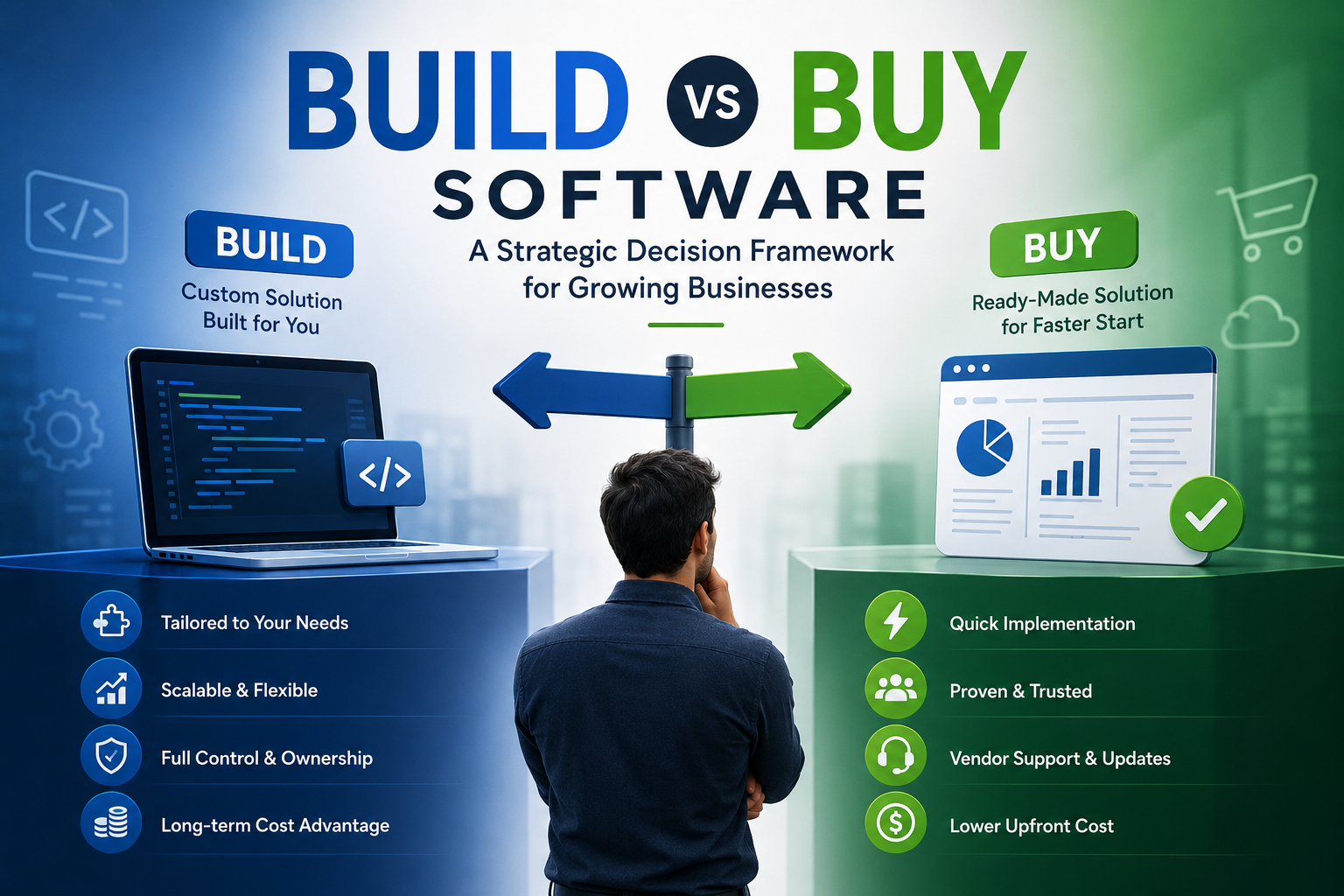
Build vs Buy Software: A Strategic Decision Framework for Growing Businesses
Published on Sep 2 months ago · By FlipCode Team
As businesses grow, so do their operational and technological requirements. The tools that once supported day-to-day activities effectively may eventually become barriers to efficiency, scalability, and innovation.
Many organizations reach a point where they find themselves managing multiple disconnected systems, relying on manual processes, or paying for software that no longer aligns with the way they operate. At this stage, a common question arises:
Should we invest in an existing software solution, or is it time to build something tailored to our business?
There is no universal answer. The right decision depends on factors such as business goals, operational complexity, budget, growth plans, and the strategic role technology plays within the organization.
While off-the-shelf software offers speed and convenience, custom software provides flexibility, control, and the ability to support unique business requirements. Understanding the advantages and limitations of each approach is essential to making an informed decision.
In this article, we explore the key considerations businesses should evaluate when deciding whether to build or buy software.
Technology has become a fundamental part of business success. From managing customer relationships and streamlining operations to improving decision-making and enhancing customer experiences, software now influences nearly every aspect of an organization.
The challenge is that software decisions are rarely short-term. The platform chosen today can impact operational efficiency, scalability, and competitiveness for years to come.
A solution selected purely because it is quick to implement may eventually restrict growth. Conversely, investing in custom development without a clear business case can lead to unnecessary costs and complexity.
The objective should not simply be to solve today's problems. It should be to implement technology that supports future growth, adapts to changing business needs, and delivers long-term value.
Buying software involves adopting an existing solution developed and maintained by a third-party provider.
Examples include customer relationship management (CRM) systems, accounting software, project management platforms, human resource management tools, and industry-specific SaaS applications.
For many organizations, purchasing software is the fastest way to address operational challenges and improve productivity.
Most SaaS solutions can be deployed within days or weeks, allowing businesses to realize value quickly without a lengthy development cycle.
Subscription-based pricing models reduce upfront costs and make budgeting more predictable, particularly for startups and small to medium-sized businesses.
Established software platforms have often been refined through years of development and real-world use. Businesses benefit from mature features, regular updates, and continuous improvements.
Software vendors typically provide technical support, training resources, security updates, and maintenance, reducing the burden on internal teams.
While purchasing software offers convenience, it also comes with limitations that can become more apparent as businesses grow.
Most software products are designed to serve a broad range of users rather than the specific needs of a single organization.
As a result, businesses often adapt their processes to fit the software rather than using software that supports their preferred way of working.
Monthly or annual licensing fees may appear manageable initially, but costs can rise significantly as user counts increase or additional functionality is required.
Modern businesses rarely rely on a single system. Connecting multiple platforms can create integration challenges that require additional tools, custom development, and ongoing maintenance.
Organizations become dependent on the software provider's roadmap, pricing structure, security policies, and feature availability. Changes made by the vendor can directly impact business operations.
Building software involves creating a solution specifically designed around an organization's unique processes, objectives, and operational requirements.
Instead of adapting business operations to fit existing software, custom development allows technology to be built around the way the business actually works.
This approach is increasingly adopted by organizations seeking greater scalability, operational efficiency, and competitive differentiation.
Custom software is designed to support specific workflows, requirements, and objectives. Every feature serves a purpose, eliminating unnecessary complexity.
As the business evolves, the software can evolve with it. New functionality, integrations, and enhancements can be introduced whenever required.
Custom software can create capabilities that competitors cannot easily replicate. In many industries, technology itself becomes a key differentiator.
Businesses retain greater control over their data, infrastructure, security practices, and future development priorities.
Custom software offers significant advantages, but it is not always the most appropriate solution.
Developing software requires investment in planning, design, development, testing, deployment, and ongoing support.
Unlike purchasing software, building a solution requires time. Depending on complexity, development can take several months before the software is ready for use.
Organizations become responsible for maintaining, improving, and securing the software over time. This requires either an internal technology team or a trusted development partner.
Rather than asking which option is better, businesses should evaluate which approach aligns most closely with their goals and operational requirements.
If the software supports a process that directly influences customer experience, operational performance, or competitive advantage, a custom solution may provide greater value.
If the process is standardized and widely adopted across industries, purchasing software is often the more practical choice.
The more specialized your workflows become, the more difficult it becomes to find software that fits perfectly.
If employees regularly rely on spreadsheets, manual workarounds, or disconnected tools, it may indicate that existing software is no longer meeting business needs.
Technology should support future growth, not just current operations.
A solution that works effectively for a team of twenty may become a limitation when supporting hundreds of users, multiple locations, or increased operational complexity.
Looking only at initial costs can be misleading.
Businesses should consider total cost of ownership, including subscription fees, licensing costs, customization expenses, integrations, maintenance requirements, and productivity impacts.
In many cases, custom software delivers greater value over the long term despite higher upfront investment.
Examples include accounting software, payroll systems, communication tools, and basic CRM platforms.
Examples include customer portals, enterprise workflow systems, industry-specific platforms, marketplace applications, and AI-powered business solutions.
Many organizations no longer view Build vs Buy as an either-or decision.
Instead, they adopt a hybrid approach that combines the strengths of both models.
Standard software is used for common business functions such as accounting, payroll, and communication, while custom solutions are developed for areas that directly impact customer experience, operational efficiency, or competitive advantage.
This approach allows businesses to control costs while maintaining the flexibility needed to innovate and grow.
The Build vs Buy decision should be approached as a strategic business consideration rather than solely a technology choice.
Organizations should first assess whether the software will support a standard business function or play a critical role in delivering unique value, improving operational efficiency, or creating a competitive advantage. For widely adopted processes such as payroll, accounting, or team collaboration, established software solutions often provide a cost-effective and reliable option. However, when business requirements become highly specialized or closely tied to long-term growth objectives, custom software may offer greater flexibility and scalability.
At Flipcoder, we recommend evaluating this decision through a long-term lens by considering factors such as business objectives, process complexity, scalability requirements, integration needs, user experience expectations, and total cost of ownership. While off-the-shelf software may deliver immediate benefits, it is important to assess whether it can continue supporting the organization's evolving needs over time.
For many growing businesses, a balanced approach often delivers the best outcomes. Standard software can be utilized for common operational functions, while custom-built solutions can address unique business challenges and strategic initiatives. This approach enables organizations to optimize costs while maintaining the flexibility required for growth and innovation.
Ultimately, the right decision is the one that aligns technology investments with business goals. Whether building, buying, or adopting a hybrid strategy, organizations should focus on selecting solutions that enhance efficiency, support future growth, and deliver sustainable business value.
At Flipcoder, we work closely with businesses to evaluate their requirements, identify the most suitable technology approach, and implement solutions that support long-term success.
Technology should not simply support business growth—it should accelerate it.
The right decision today can become a foundation for innovation, efficiency, and sustained competitive advantage for years to come.
Build vs Buy Software: A Strategic Decision Framework for Growing Businesses
Why This Decision Matters More Than Ever
Understanding the "Buy" Approach
Advantages of Buying Software
Faster Implementation
Lower Initial Investment
Proven Functionality
Ongoing Support
The Challenges of Buying Software
Limited Flexibility
Increasing Subscription Costs
Integration Complexity
Vendor Dependency
Understanding the "Build" Approach
Advantages of Building Custom Software
Tailored to Business Needs
Scalability and Flexibility
Competitive Advantage
Greater Control
The Challenges of Building Software
Higher Initial Investment
Longer Time to Market
Ongoing Ownership
Key Questions to Guide the Decision
Is the Process Strategic to Your Business?
How Unique Are Your Requirements?
What Are Your Growth Plans?
Have You Evaluated Long-Term Costs?
When Buying Software Makes Sense
When Building Software Makes Sense
The Rise of Hybrid Strategies
Our Strategic Recommendation