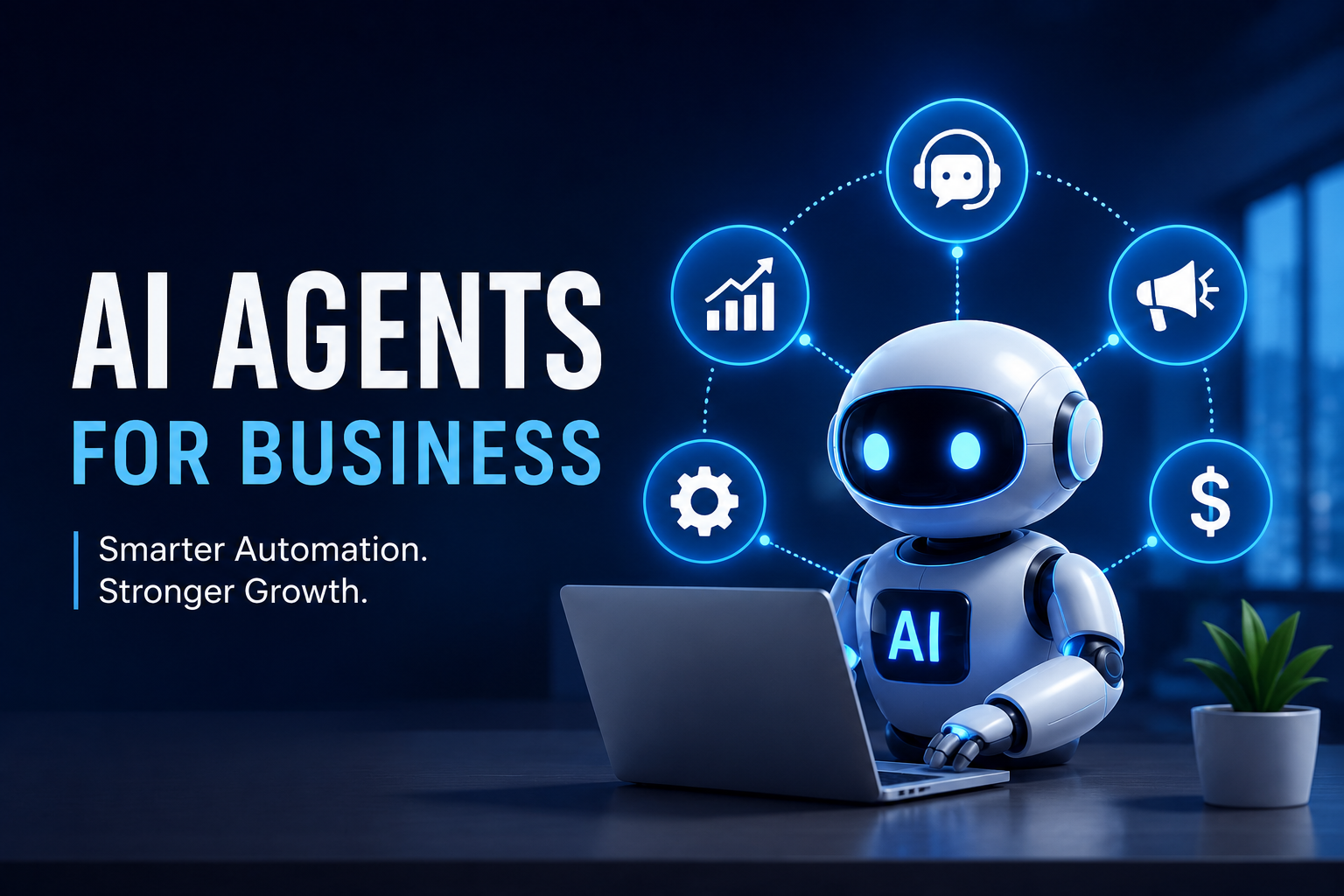
AI Agents for Business: Why They Are Becoming the Next Digital Workforce
Published on Sep 4 months ago · By FlipCode Team
Imagine having a team member who never sleeps, never forgets a task, can process thousands of requests simultaneously, and continuously learns from every interaction.
A few years ago, this sounded like science fiction. Today, it is becoming a business reality through AI Agents.
Businesses have already embraced automation tools, chatbots, and machine learning systems. However, a new wave of artificial intelligence is emerging—one that goes beyond answering questions or performing predefined tasks.
For years, businesses have relied on automation tools to reduce repetitive work. While these solutions improved efficiency, they came with significant limitations.
Traditional automation follows predefined instructions. If an unexpected situation occurs, the workflow usually breaks and requires human intervention.
Consider a customer support chatbot. It can answer common questions, but when faced with a unique request, it often reaches a dead end and transfers the customer to a human representative.
AI Agents don't simply follow scripts. They understand context, gather information, evaluate options, and take action to achieve a desired outcome.
The business case for AI Agents is becoming increasingly difficult to ignore.
Organizations face growing pressure to improve efficiency while maintaining exceptional customer experiences. At the same time, labor costs continue to rise and customer expectations are higher than ever.
AI Agents address these challenges by acting as scalable digital workers that can operate around the clock.
Unlike human teams, AI Agents can handle thousands of interactions simultaneously while maintaining consistent performance.
Employees spend less time on repetitive administrative tasks and more time focusing on innovation, strategy, and customer relationships.
The most successful AI implementations are not replacing entire departments. Instead, they eliminate bottlenecks and streamline processes that consume valuable time and resources.
Customer support remains one of the strongest use cases for AI Agents.
This improves customer satisfaction while reducing support workloads.
Sales teams often spend a significant amount of time on administrative activities rather than revenue-generating tasks.
AI Agents automate these activities, allowing sales professionals to focus on closing deals.
Marketing departments generate enormous volumes of data every day.
The result is more efficient campaigns and improved return on marketing investments.
Many organizations overlook the value AI Agents can bring to internal workflows.
These improvements often generate significant productivity gains across the entire organization.
One common misconception is that AI Agents are only accessible to large enterprises with massive technology budgets.
In reality, implementation costs vary depending on business goals and technical requirements.
Organizations should approach AI implementation as a strategic investment rather than a one-time technology purchase.
The objective is not simply deploying AI technology. The goal is creating measurable business value through increased efficiency, reduced costs, and improved customer experiences.
The capabilities of AI Agents are evolving at an extraordinary pace.
Today's systems can automate individual workflows. Tomorrow's AI Agents will collaborate with one another, manage increasingly sophisticated business operations, and provide deeper strategic insights.
Businesses may soon operate with interconnected AI Agents managing customer service, sales, finance, operations, and analytics simultaneously.
AI Agents represent one of the most significant advancements in business technology since the rise of cloud computing.
By combining intelligence, automation, and decision-making capabilities, they enable businesses to operate more efficiently, serve customers better, and scale faster.
As AI continues to evolve, the digital workforce is no longer a vision of the future. It is already reshaping how modern businesses operate, compete, and grow.
AI Agents for Business: Why They Are Becoming the Next Digital Workforce
1. The Shift From Automation to Autonomous Intelligence
How AI Agents Are Different
Traditional automation follows instructions. AI Agents pursue outcomes.
2. Why Businesses Are Paying Attention
Business Benefits of AI Agents
3. Real-World Business Applications
3.1 Customer Service
3.2 Sales Operations
3.3 Marketing Optimization
3.4 Internal Operations
4. Understanding the Cost of AI Agent Implementation
Factors That Influence Cost
5. The Future of AI Agents
What the Future May Include
The question is no longer whether AI Agents will become part of business operations. The real question is how quickly organizations can identify the right opportunities and implement them effectively.
Conclusion
Key Takeaways
The Bottom Line