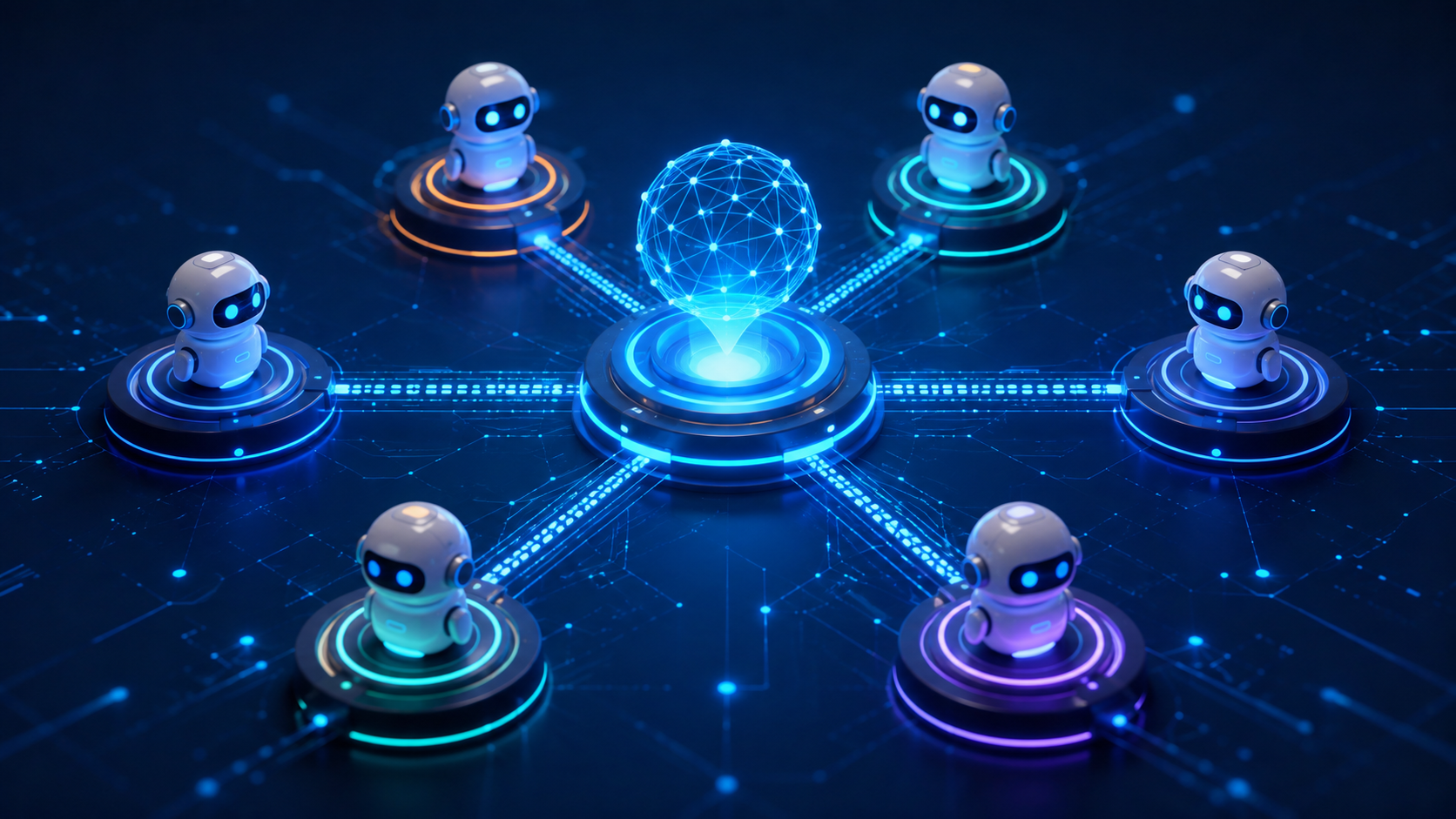
How AI Agents Communicate Using A2A Protocol: A Complete Guide to the Future of Multi-Agent AI
Published on Sep 1 month ago · By FlipCode Team
How independent AI agents discover each other, share work, and deliver one unified result. Artificial intelligence has evolved far beyond chatbots that simply answer questions or generate text. Modern AI systems are becoming autonomous agents capable of reasoning, planning, using tools, making decisions, and collaborating with other AI agents to accomplish complex tasks. As organizations adopt AI at scale, a new challenge emerges: how do independent AI agents communicate with each other? Imagine asking an AI assistant to organize an international business trip. Instead of relying on a single AI model, one agent could book flights, another could reserve hotels, a third could manage your calendar, and another could calculate expenses. While each agent specializes in a specific task, they must exchange information seamlessly to deliver a unified result. This is where the Agent-to-Agent (A2A) Protocol comes in. Designed as an open communication standard, A2A enables AI agents to discover one another, exchange tasks, share context, and collaborate securely across different systems. The Agent-to-Agent (A2A) Protocol is an open communication standard that enables autonomous AI agents to interact with one another using structured, standardized messages. Instead of building custom integrations between every AI application, developers can implement a common communication layer that allows agents from different vendors, frameworks, or organizations to collaborate seamlessly. Think of it this way: As enterprise AI ecosystems continue to grow, standardized communication becomes essential. Without it, every new AI agent would require separate integrations with every other agent, creating unnecessary complexity and maintenance overhead. Traditional AI applications usually rely on a single large language model to complete every task. While this works for simple requests, modern business processes often involve multiple specialized domains. Consider the following request: Completing this request efficiently requires multiple specialized capabilities: If these agents cannot communicate, each operates independently, forcing the primary AI system to coordinate everything manually. The A2A Protocol allows these specialized agents to exchange tasks, context, and responses automatically, enabling them to function as one intelligent system. Before exploring A2A further, it's important to understand what an AI agent actually is. An AI agent is an intelligent software system capable of understanding objectives, making decisions, using external tools, executing tasks, and adapting based on context. Unlike traditional chatbots that simply generate responses, AI agents perform real actions. For example, an AI travel agent can: When multiple specialized agents collaborate to complete larger workflows, they form a Multi-Agent System (MAS). The A2A Protocol acts as the communication layer that enables this collaboration. The communication process follows a structured workflow designed for efficiency and scalability: Rather than assigning every responsibility to one AI model, the coordinator delegates work to specialized agents, collects their responses, and delivers a single, unified answer to the user. Before an AI agent can collaborate, it must discover which agents are available. Each agent advertises its capabilities, allowing other agents to locate the right specialist for a particular task. For example, available agents might include a Customer Support Agent, Finance Agent, CRM Agent, Coding Agent, Data Analytics Agent, or Weather Agent. Agent discovery ensures that tasks are routed to the most appropriate AI service. Once discovered, agents exchange metadata describing what they can do. For example: This information helps the coordinator determine which agent should handle each task. The coordinator sends structured requests rather than natural language conversations. For example: Structured communication improves consistency, automation, and interoperability. Complex workflows require agents to share relevant information, including user preferences, authentication details, business rules, previous conversation history, project information, and file references. Context sharing eliminates repetitive processing and enables agents to work efficiently without requesting the same information repeatedly. Each AI agent independently performs its assigned responsibility — querying enterprise databases, calling third-party APIs, performing financial calculations, running AI models, creating reports, or executing business workflows. Multiple agents can perform these operations simultaneously, significantly improving execution speed. Once each agent completes its task, the coordinator gathers all responses, validates outputs, resolves conflicts, combines results, and formats the final response. From the user's perspective, everything appears as a single intelligent conversation, even though multiple AI agents collaborated behind the scenes. Imagine an executive asks: "Prepare my quarterly business review presentation." Instead of relying on one AI model, several specialized agents collaborate: Finally, the Coordinator Agent combines all outputs into a polished presentation. This collaborative approach delivers better accuracy, improved efficiency, and faster execution than relying on a single AI system. Scalability — Organizations can continuously add new AI agents without redesigning their existing architecture. Modularity — Each AI agent focuses on one specialized responsibility, making systems easier to develop, maintain, and upgrade. Parallel Processing — Multiple agents can execute tasks simultaneously, reducing overall execution time. Vendor Independence — Agents built using different AI models or frameworks can communicate through a common protocol, combining agents powered by OpenAI, Anthropic, Google Gemini, or internal enterprise models. Improved Accuracy — Specialized AI agents generally outperform general-purpose systems within their respective domains. Fault Isolation — If one agent becomes unavailable, other agents continue functioning without affecting the entire system. Different agents manage billing, technical support, refund processing, and order tracking. Healthcare organizations can deploy diagnosis agents, medical record agents, appointment scheduling agents, and prescription verification agents. Development platforms may use code generation agents, unit testing agents, documentation agents, security review agents, and deployment agents — together automating significant portions of the software development lifecycle. Banks can implement specialized agents for fraud detection, risk assessment, investment recommendations, compliance monitoring, and customer verification. Large organizations can connect AI agents across HR, CRM, ERP, procurement, finance, and inventory management, creating intelligent enterprise-wide automation. Many developers assume A2A and MCP solve the same problem, but they serve different purposes. A simple way to understand the difference: MCP helps an AI agent use tools. A2A helps AI agents work together. In many enterprise AI systems, both protocols complement each other — AI agents communicate through A2A while using MCP to access external systems and business data. Authentication — Agents must securely verify each other's identities. Authorization — Not every agent should have permission to access every task or resource. Context Synchronization — Maintaining consistent context across multiple distributed agents can become complex. Latency — Communication between geographically distributed agents may introduce delays. Trust — Organizations need mechanisms to validate third-party AI agents before collaboration. Error Recovery — Systems should gracefully recover when one or more agents fail during execution. As AI adoption continues to grow, experts believe that collaborative AI ecosystems will become the standard architecture for enterprise applications. Future developments may include: Instead of relying on one massive AI model, organizations will increasingly deploy networks of specialized AI agents collaborating through standardized communication protocols like A2A. The Agent-to-Agent (A2A) Protocol represents a significant advancement in the evolution of artificial intelligence. By providing a standardized method for AI agents to discover each other, exchange information, delegate tasks, and combine results, A2A enables the creation of scalable, modular, and collaborative AI systems. As businesses continue integrating AI into customer service, software development, finance, healthcare, and enterprise operations, the ability for AI agents to communicate effectively will become increasingly important. Combined with technologies such as the Model Context Protocol (MCP), A2A lays the foundation for intelligent ecosystems where specialized AI agents work together to solve complex business challenges efficiently. For developers, architects, and technology leaders, understanding the A2A Protocol today means preparing for the future of enterprise AI — where collaboration between intelligent agents becomes the driving force behind innovation and automation.The Agent-to-Agent (A2A) Protocol
What is the A2A Protocol?
Why Do AI Agents Need A2A?
"Plan my three-day business trip to Singapore next month with a total budget under $2,500."
Understanding AI Agents
How the A2A Protocol Works
Core Components of the A2A Protocol
1. Agent Discovery
2. Capability Exchange
Agent: Finance Agent
Capabilities:
  - Expense Analysis
  - Budget Planning
  - Currency Conversion
  - Financial Reporting
3. Task Delegation
{
  "task": "Generate Quarterly Sales Report",
  "priority": "High",
  "deadline": "2 Hours",
  "format": "PDF"
}
4. Context Sharing
5. Task Execution
6. Response Aggregation
A Practical Example
Benefits of the A2A Protocol
Real-World Applications
Customer Support
Healthcare
Software Development
Financial Services
Enterprise Automation
A2A vs MCP: What's the Difference?
A2A Protocol MCP (Model Context Protocol) Connects AI Agent ↔ AI Agent AI Model ↔ External Tools Purpose Enables collaboration between agents Connects AI to APIs, databases, and files Focus Coordination and delegation Accessing external resources Supports Multi-agent workflows Context and tool access Challenges of Implementing A2A
The Future of Multi-Agent AI
Conclusion